
Beyond Tuition: Supporting College Success for Foster-Experienced Students

For students with foster care experience, gaining admission to college is a significant achievement. But admission is only the beginning.
A 2025 systematic review of 17 studies found that postsecondary enrollment among young people with foster care experience ranged from 29% to 64%. Yet only approximately 8% to 12% completed a two- or four-year degree by their mid-to-late twenties. By comparison, approximately 49% of young adults in the general population completed a degree.
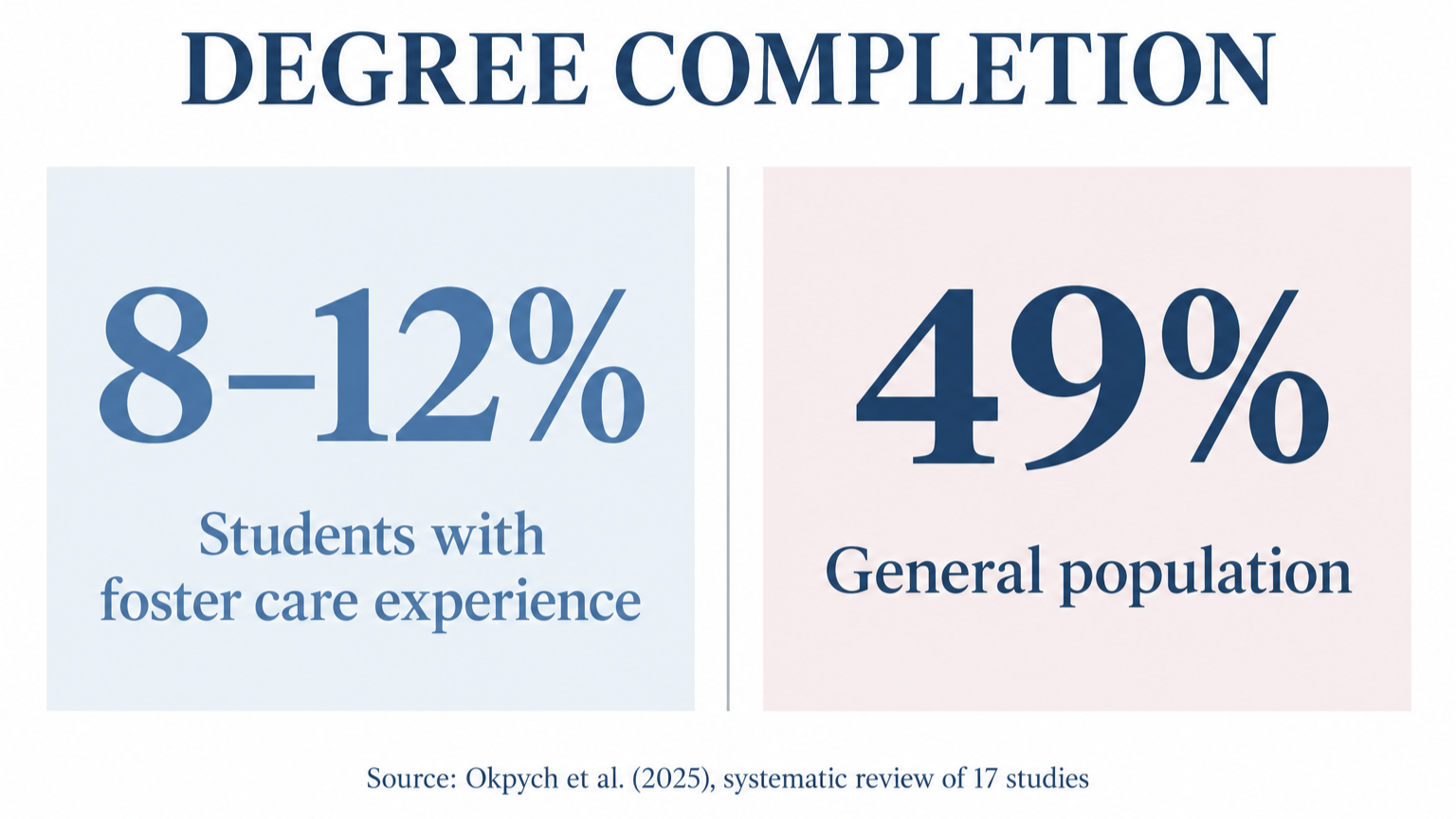
These findings challenge the frequently repeated claim that only 3% of young people with foster care experience graduate from college. The newer research presents a more accurate and somewhat more hopeful picture, but it also confirms that substantial disparities remain.
The question is no longer simply whether students can gain college access. It is also whether the systems surrounding them are prepared to help them remain enrolled, progress academically, and complete a meaningful credential.
Financial access matters, but it is not the entire solution
Florida has taken important steps to reduce financial barriers. Under Section 1009.25, Florida Statutes, eligible students with foster care experience can receive tuition and fee exemptions at Florida public colleges, universities, and certain workforce-education programs. The Florida Department of Children and Families provides additional information about eligibility and access to the exemption.
Florida law also recognizes that financial assistance alone is not enough. Section 409.1452, Florida Statutes calls for collaboration among the Department of Children and Families, the Florida College System, the State University System, and the Department of Education. Institutions enrolling students who receive qualifying tuition exemptions must also designate a knowledgeable and accessible employee to serve as a liaison and assist those students.
These policies create an important foundation. However, eliminating tuition does not automatically eliminate the other barriers students may encounter.
A student may still be trying to understand financial-aid requirements, secure stable housing, locate academic assistance, balance employment, navigate transportation challenges, build supportive relationships, or determine which campus office can address a particular concern. When responsibility is distributed across multiple agencies and institutional departments, students can be left to connect the pieces themselves.
The transition should not depend on a student’s ability to navigate disconnected systems
Beyond College Access brings a perspective informed by more than 25 years of leadership across K–12 education, higher education, and nonprofit organizations. Its founder’s experience includes working with first-generation, low-income, and historically underserved students and leading statewide student-success initiatives and partnerships involving school districts, colleges, universities, and community organizations.
One lesson has remained consistent: students are more likely to succeed when the organizations surrounding them share responsibility for the outcome.
Students with foster care experience may interact with child-welfare professionals, independent-living staff, financial-aid offices, academic advisers, student-support programs, faculty members, career services, and community organizations. Each may provide valuable assistance, but the overall experience can remain fragmented if the organizations do not have clear transition processes, referral practices, communication protocols, and shared measures of success.
This is not a matter of asking individual professionals to care more. Many already care deeply. It is a matter of ensuring that caring professionals are supported by coordinated systems.
Four questions institutions should consider
1. Is the pathway clear?
Students and the professionals supporting them should understand the steps from high school completion through college enrollment, financial-aid processing, orientation, academic support, persistence, and career preparation.
A pathway should identify responsibilities, timelines, referral points, and the people students can contact when they encounter difficulty.
2. Are staff prepared?
Case managers, counselors, educators, financial-aid professionals, advisers, and student-support personnel may understand their own responsibilities without fully understanding how their work connects to the responsibilities of other organizations.
Cross-sector professional development can help staff recognize common barriers, provide accurate information, make effective referrals, and avoid requiring students to repeatedly explain their circumstances.
3. Are partners coordinating their efforts?
Strong partnerships require more than occasional meetings or informal relationships. They need agreed-upon processes, responsible individuals, appropriate methods of communication, and a shared understanding of what should happen when a student needs assistance.
Coordination should make the student experience easier, not add another layer of complexity.
4. Are organizations measuring what happens after enrollment?
Enrollment is an important milestone, but it should not be the final measure of success.
Organizations should also examine early momentum, persistence, credit completion, academic standing, use of support services, credential completion, and career transition. They should consider where students disengage and whether existing services are reaching the students for whom they were designed.
Moving from access to completion
The disparities reflected in the research are not evidence that students with foster care experience lack ability, motivation, or potential. They are a call to examine whether institutional practices and cross-sector partnerships consistently provide the conditions students need to succeed.
Tuition assistance opens an important door. The next challenge is ensuring that students encounter a coordinated pathway once they walk through it.
Building on its experience in student success and cross-sector partnerships, Beyond College Access is expanding its work to help colleges, child-welfare organizations, and community partners strengthen postsecondary transitions, staff readiness, institutional coordination, and outcome measurement for students with foster care experience.
Let’s strengthen the pathway together
Is your college, child-welfare organization, or community-based organization working to improve postsecondary outcomes for students with foster care experience? Beyond College Access welcomes conversations about current practices, persistent barriers, and potential partnership opportunities.